
If you spend most of your day sitting at a desk, you already know the feeling — that dull ache in your lower back that builds slowly through the morning, the tightness across your shoulders by mid-afternoon, and the stiff neck that greets you when you finally stand up at the end of the day. Back pain at work is one of the most common complaints we hear about here at Sarasota Chiropractic And Physical Therapy, and the good news is that a lot of it is preventable. Understanding how your workspace affects your spine is the first step toward feeling better — and staying that way.
What Is Workplace Ergonomics?
Ergonomics is the science of designing your work environment to fit your body — rather than forcing your body to adapt to your environment. When your workstation is set up properly, your muscles, joints, and spine can maintain a natural, neutral position throughout the day. When it isn’t, your body compensates in ways that create strain, tension, and eventually pain — especially in the back, neck, and hips.
- What Is Workplace Ergonomics?
- Why Sitting Hurts Your Back
- Common Causes of Office-Related Back Pain
- How Chiropractic Care Fits Into the Picture
- Practical Ergonomic Tips for a Pain-Free Workday
- When to See a Chiropractor for Work-Related Back Pain
- Ergonomic Setup: Common Mistakes vs. Corrections
- Myths vs. Facts About Back Pain at Work
- Final Thoughts
- Frequently Asked Questions
- TL;DR Summary
Why Sitting Hurts Your Back
It might seem strange that something as passive as sitting could cause so much pain. After all, you’re not lifting anything heavy or doing strenuous activity. But from a biomechanical standpoint, prolonged sitting places a significant amount of stress on your lumbar spine — the lower portion of your back that curves inward naturally.
When you sit, especially in a slouched or forward-leaning position, that natural lumbar curve tends to flatten or even reverse. This puts pressure on the intervertebral discs, compresses the facet joints, and forces the surrounding muscles to work overtime just to hold you upright. Over time, this repetitive strain adds up. What starts as occasional discomfort can become chronic pain that follows you home from the office.
Research published through organizations like the National Institutes of Health has consistently shown that sedentary behavior and prolonged static postures are significant contributors to musculoskeletal disorders, particularly in the lower back and neck. Here in Sarasota, many of our patients who work in office settings — whether in downtown offices, home workspaces, or remote setups — come in describing the exact same pattern of pain that builds gradually over weeks or months.
Common Causes of Office-Related Back Pain
Back pain at work rarely has a single cause. More often, it’s the result of several overlapping factors that compound each other throughout the day. Understanding what’s driving your pain is essential to addressing it effectively.
One of the most common culprits is poor seated posture. When you slouch forward, round your shoulders, or jut your head toward your screen, you shift your center of gravity away from its natural position. Your spine has to work against gravity in a mechanically inefficient way, and the muscles that support it fatigue much faster than they should.
Monitor height is another frequently overlooked issue. If your screen is too low, you’ll be looking downward for hours at a time, creating a forward head posture that can add significant stress to the cervical spine. If it’s too high, you’ll strain the muscles at the base of your skull. Similarly, a chair that doesn’t support your lumbar region leaves your lower back unsupported and vulnerable to strain.
Repetitive mouse and keyboard use can also contribute to tension that radiates from the wrists and forearms into the shoulders and upper back. And perhaps the most underestimated cause of all is simply not moving enough. Staying in any position — even a good one — for too long causes muscles to tighten and circulation to slow down.
How Chiropractic Care Fits Into the Picture
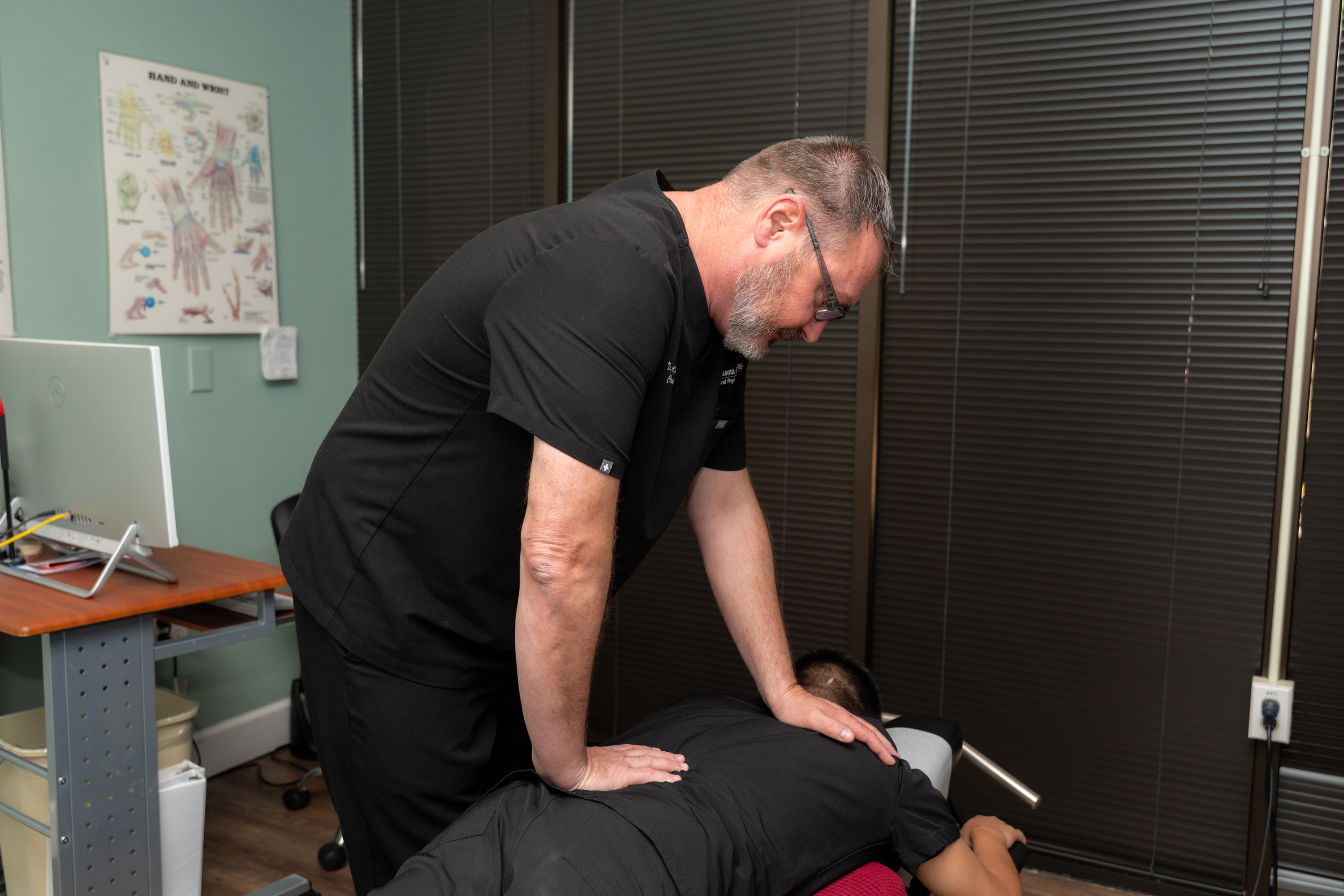
Chiropractic care takes a whole-body, non-invasive approach to understanding and addressing back pain. At Sarasota Chiropractic And Physical Therapy, Dr. Abraham Kozma evaluates not just where you hurt, but how your spine is moving, how your posture has adapted over time, and what structural imbalances may be contributing to your discomfort.
Spinal adjustments — the hallmark of chiropractic care — work to restore proper alignment and movement to the joints of the spine. When vertebrae are restricted or misaligned, the surrounding nerves, muscles, and tissues can become irritated or compressed. Gentle, targeted adjustments help restore normal motion, which can reduce tension, improve circulation, and allow the body to heal more effectively.
Because Sarasota Chiropractic And Physical Therapy also integrates physical therapy services, patients benefit from a more comprehensive approach. Dr. Abraham Kozma and the care team can combine spinal care with targeted rehabilitative exercises, soft tissue work, and postural retraining — all of which are particularly valuable for patients whose pain is rooted in occupational habits. Evidence from organizations like the American Chiropractic Association and the National Center for Complementary and Integrative Health supports chiropractic care as an effective, conservative option for managing musculoskeletal back pain without surgery or medications.
Just as important, Dr. Kozma can help identify the specific postural patterns or movement habits that are driving your pain, and provide personalized guidance on how to adjust your workspace and daily routine to prevent recurrence.
Practical Ergonomic Tips for a Pain-Free Workday
The most powerful thing you can do for your back at work doesn’t require expensive equipment or a complete office overhaul. Small, intentional adjustments to how you sit, position your tools, and move throughout the day can make a dramatic difference. Here are some of the most impactful changes to consider.
Start with your chair. Your feet should rest flat on the floor, and your knees should be roughly level with or slightly below your hips. Your chair should support the natural inward curve of your lower back — if it doesn’t have built-in lumbar support, a small rolled towel or lumbar cushion placed at the small of your back can work well. Your hips should be pushed back into the seat, not perched near the edge.
Next, check your monitor. The top of your screen should be at or just below eye level, positioned about an arm’s length away from your face. This keeps your head in a neutral position and reduces the forward head posture that strains the neck and upper spine. If you’re using a laptop, consider a separate keyboard and mouse with a laptop stand to raise the screen to the appropriate height.
Your keyboard and mouse should be positioned so that your elbows are bent at roughly 90 degrees and your wrists remain relatively flat and relaxed as you type. Reaching too far forward or positioning your arms too high or too low creates tension in the shoulders, neck, and upper back that accumulates throughout the day.
One of the most important ergonomic habits is simply moving more. Set a reminder to stand up, stretch, or take a short walk at least once every 30 to 45 minutes. Even a brief two-minute break to walk to the water cooler or do a simple stretch can reset your posture, improve circulation, and give your spinal muscles a chance to recover. Movement is medicine — especially for a spine that spends most of the day in a static position.
When to See a Chiropractor for Work-Related Back Pain
Many people wait far too long before seeking care for back pain, assuming it will resolve on its own. And sometimes it does — but often, the underlying postural patterns and joint restrictions that caused the pain in the first place remain unchanged, leading to repeated flare-ups or gradual worsening over time.
If your back pain has been present for more than a few days, is consistently getting worse, or is affecting your ability to concentrate at work or enjoy your life outside of it, those are clear signs that a professional evaluation is warranted. Pain that radiates into your buttocks, thigh, or down the leg — particularly if accompanied by numbness or tingling — may suggest nerve involvement and should be evaluated promptly.
There are also red flags that require immediate medical attention rather than chiropractic care. These include back pain accompanied by loss of bladder or bowel control, unexplained weight loss, fever, or pain that follows significant trauma. In those cases, please seek emergency medical care right away.
For the vast majority of office workers dealing with everyday back, neck, or shoulder pain, chiropractic care is a safe and appropriate first step. The team at Sarasota Chiropractic And Physical Therapy in Sarasota, FL welcomes patients at all stages — whether you’re dealing with a new flare-up or have been managing chronic discomfort for years.
Ergonomic Setup: Common Mistakes vs. Corrections
| Ergonomic Element | Common Mistake | Corrected Setup |
|---|---|---|
| Chair Height | Too low or too high, causing knees to be above hips or feet to dangle | Feet flat on the floor, knees at or slightly below hip level |
| Lumbar Support | No support, causing the lower back to flatten or round | Chair back or cushion supporting the natural inward curve of the lower back |
| Monitor Position | Screen too low or too close, leading to neck flexion and eye strain | Top of screen at or just below eye level, approximately arm’s length away |
| Keyboard & Mouse | Placed too far forward or too high, creating shoulder and wrist strain | Elbows bent at ~90 degrees, wrists flat, mouse within easy reach |
| Movement Frequency | Sitting for hours without breaks, leading to muscle fatigue and stiffness | Standing or moving briefly every 30–45 minutes |
| Head Position | Head jutting forward toward the screen (forward head posture) | Ears aligned over the shoulders, chin gently tucked |
Myths vs. Facts About Back Pain at Work
Myth: Back pain is just a normal part of getting older — there’s nothing you can do about it.
Fact: While the risk of certain spine-related conditions does increase with age, work-related back pain is most commonly the result of postural habits, movement patterns, and biomechanical factors — not aging alone. Many people in their 40s, 50s, and beyond find significant relief with chiropractic care, ergonomic changes, and targeted rehabilitation. Age doesn’t have to mean pain.
Myth: You should rest completely and avoid movement when your back hurts.
Fact: This is one of the most persistent myths in back pain management. Current evidence, including guidelines from organizations like the National Institute for Health and Care Excellence (NICE), recommends staying active and avoiding prolonged bed rest for most cases of non-specific back pain. Gentle movement, walking, and guided exercise tend to support recovery better than complete rest.
Myth: A standing desk will solve all your back pain problems.
Fact: Standing desks can be a helpful tool when used correctly, but standing all day creates its own set of issues — including foot fatigue, knee strain, and lower back stiffness. The key is variation: alternating between sitting, standing, and moving throughout the day. A standing desk is most beneficial when it’s part of a broader ergonomic strategy, not a standalone solution.
Myth: Chiropractic adjustments are only for severe or acute injuries.
Fact: Chiropractic care is equally valuable for mild, moderate, and chronic conditions — including the kind of gradual, cumulative back pain that builds from everyday office work. Many patients in Sarasota come in for regular maintenance care as a proactive strategy, long before their discomfort reaches a severe level.
Myth: You just need to “power through” work-related back pain — it’ll go away on its own.
Fact: Acute back pain can sometimes resolve on its own within a few weeks. But if the underlying postural habits and spinal restrictions aren’t addressed, the pain often returns — and can become more difficult to manage over time. Early evaluation and conservative care, like what’s offered at Sarasota Chiropractic And Physical Therapy, can help interrupt that cycle before it becomes a chronic issue.
Final Thoughts
Back pain at work is incredibly common — but it isn’t something you have to simply accept as the price of your profession. Whether you work from a home office in Sarasota or commute to a downtown workspace every day, the principles of good ergonomics and spine health apply equally. Small changes in how you sit, where you position your screen, and how often you move can make a meaningful difference in how you feel at the end of each workday.
At Sarasota Chiropractic And Physical Therapy, Dr. Abraham Kozma and our care team are here to support the Sarasota, FL community with thoughtful, patient-centered care. We believe that understanding your body is the foundation of lasting health — and we’re committed to helping you do exactly that. If your back has been speaking up during your workday, we’d encourage you to listen. Getting evaluated sooner rather than later gives you the best chance of resolving your pain and protecting your spine for the long run.
Frequently Asked Questions
How long does it take to see improvement from ergonomic changes?
Many people notice some improvement within one to two weeks of consistently applying ergonomic corrections. However, if your pain has been building over months or years, the structural changes in your spine may require professional care alongside lifestyle adjustments to fully resolve.
Can a chiropractor help with neck pain from computer use?
Yes. Forward head posture from prolonged screen use is a very common driver of neck pain, upper back tension, and even headaches. Chiropractic adjustments combined with postural guidance can address both the symptoms and the underlying mechanical causes.
Is it safe to see a chiropractor if I have a herniated disc from sitting too much?
Chiropractic care is often considered a conservative, non-surgical option for disc-related issues, though the approach will depend on the severity and specifics of your condition. Dr. Abraham Kozma would conduct a thorough evaluation before recommending any course of care to ensure it’s appropriate for your individual situation.
How often should I stand up from my desk during the workday?
General guidance from ergonomics and musculoskeletal health experts suggests taking a movement break every 30 to 45 minutes. Even standing briefly, walking to get water, or doing a simple stretch helps reduce the cumulative strain of prolonged sitting.
Do I need special equipment for a good ergonomic setup?
Not necessarily. While ergonomic chairs and monitor stands can help, many effective adjustments involve repositioning what you already have — raising your laptop on a stack of books, using a rolled towel for lumbar support, or simply being more intentional about your posture. A professional evaluation can help identify your biggest areas of opportunity.
Where can I find chiropractic care for back pain near me in Sarasota?
Sarasota Chiropractic And Physical Therapy serves patients throughout the Sarasota, FL area. Dr. Abraham Kozma and the care team offer a combined chiropractic and physical therapy approach that’s well-suited for work-related back and neck pain.
TL;DR Summary
- Prolonged sitting with poor posture places significant stress on the spine and is a leading cause of work-related back pain.
- Key ergonomic fixes include proper chair height, lumbar support, monitor positioning at eye level, and keeping your keyboard within comfortable reach.
- Movement is essential — aim to take a short break every 30–45 minutes to counteract the effects of static sitting.
- Chiropractic care from Dr. Abraham Kozma at Sarasota Chiropractic And Physical Therapy can help address both the symptoms and the root causes of office-related back pain.
- Don’t wait for pain to become severe — early evaluation and simple lifestyle changes can prevent acute discomfort from becoming a chronic problem.